

26 / Schengen Danışmanlık — Visa Consultancy · Web + Ads
A new website and Google Ads for a visa consultancy
Schengen Danışmanlık provides Schengen visa consultancy and file preparation in Beylikdüzü, Istanbul. We built its site on the Mars CMS platform: each of the 29 Schengen countries has its own page, with the application centre and the reference amount from official sources. Its Google Ads cost per click is 59% below the market average; PageSpeed Insights: 96 on mobile, 100 on desktop.
- Web Design
- Content Architecture
- Google Ads
- Measurement
Client

Schengen Danışmanlık · live
Year
2026
SITE SHOWCASE
Every line was written for Schengen Danışmanlık. Not a template — a hand-coded interface made for the brand.
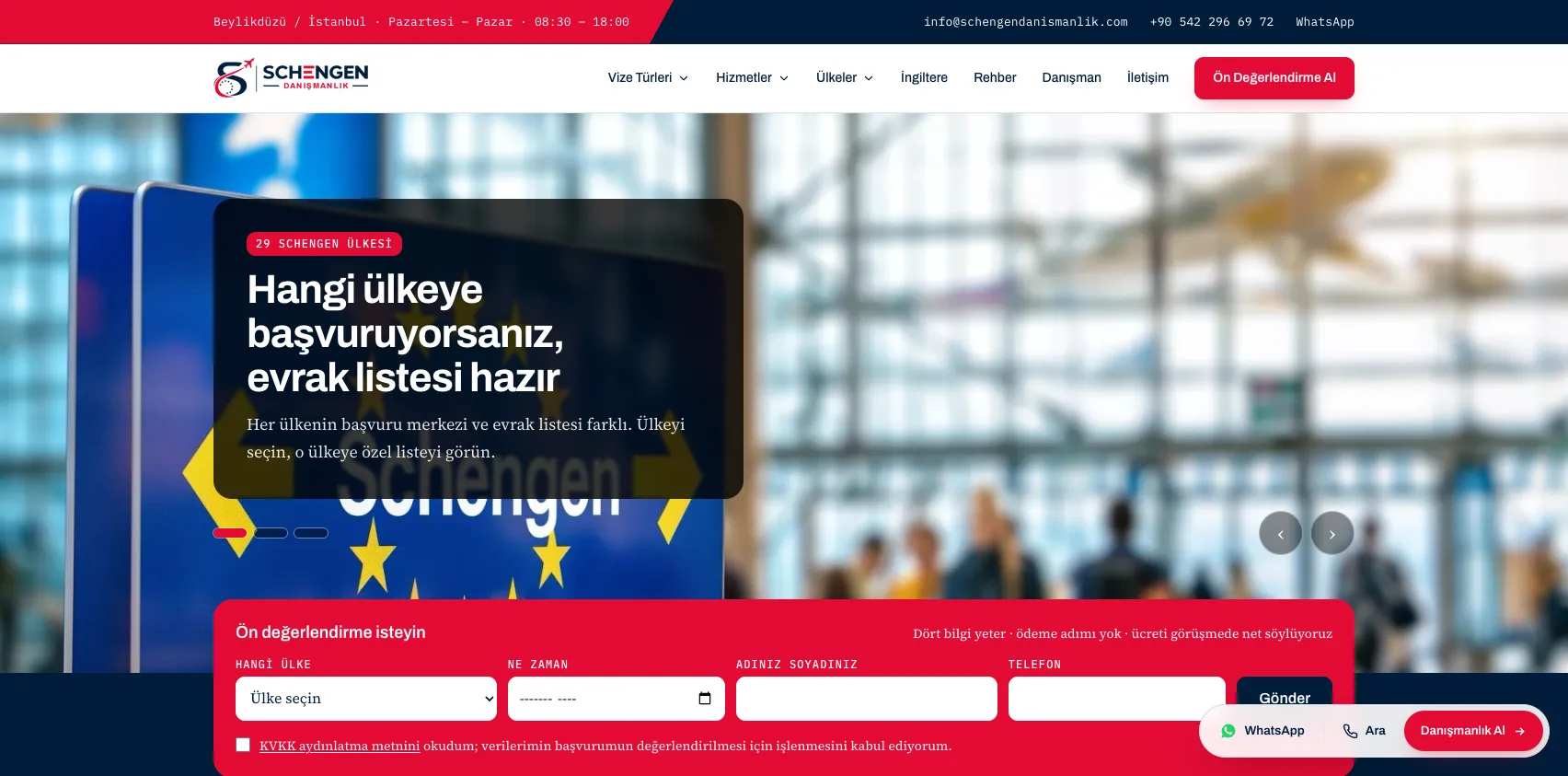
Schengen Danışmanlık · live
Explore the live site (opens in a new tab)CASE NOTE
Index 26 / 39
Schengen Danışmanlık has provided Schengen visa consultancy and file preparation in Beylikdüzü, Istanbul, since 2015. Tourist, business and student applications, corporate files and reapplications after a refusal are its main lines of work; travel services such as flights, hotels and travel insurance come under the same roof.
What a visa applicant needs to know changes by country: which centre takes the application in Türkiye, which mission decides, how much money should show per day in the account, how the fee is paid. This information exists in official sources, but it is spread across 29 countries, often stale and written differently on every site.
We built the site on Mars Creative’s content platform, Mars CMS. The site explains each country by its own rules and sources, states the firm’s limits plainly and takes the pre-assessment request by the shortest route; the Google Ads campaign and conversion measurement are part of the same job.
APPROACH
Built step by step.
Someone looking for a visa types the country into Google first: Spain visa, Hungary visa, Greece visa. Most of these searches want information, a small share want a service, and one page cannot serve both. The sector also has a trust problem: plenty of success rates and guarantees, little information with a named source. The job of the site is to explain each country by its own rules with a verified source, say plainly what the firm does and does not do, and take the pre-assessment request by the shortest route. The work ran under six headings.
-
PHASE 01
A home page that opens with a country picker
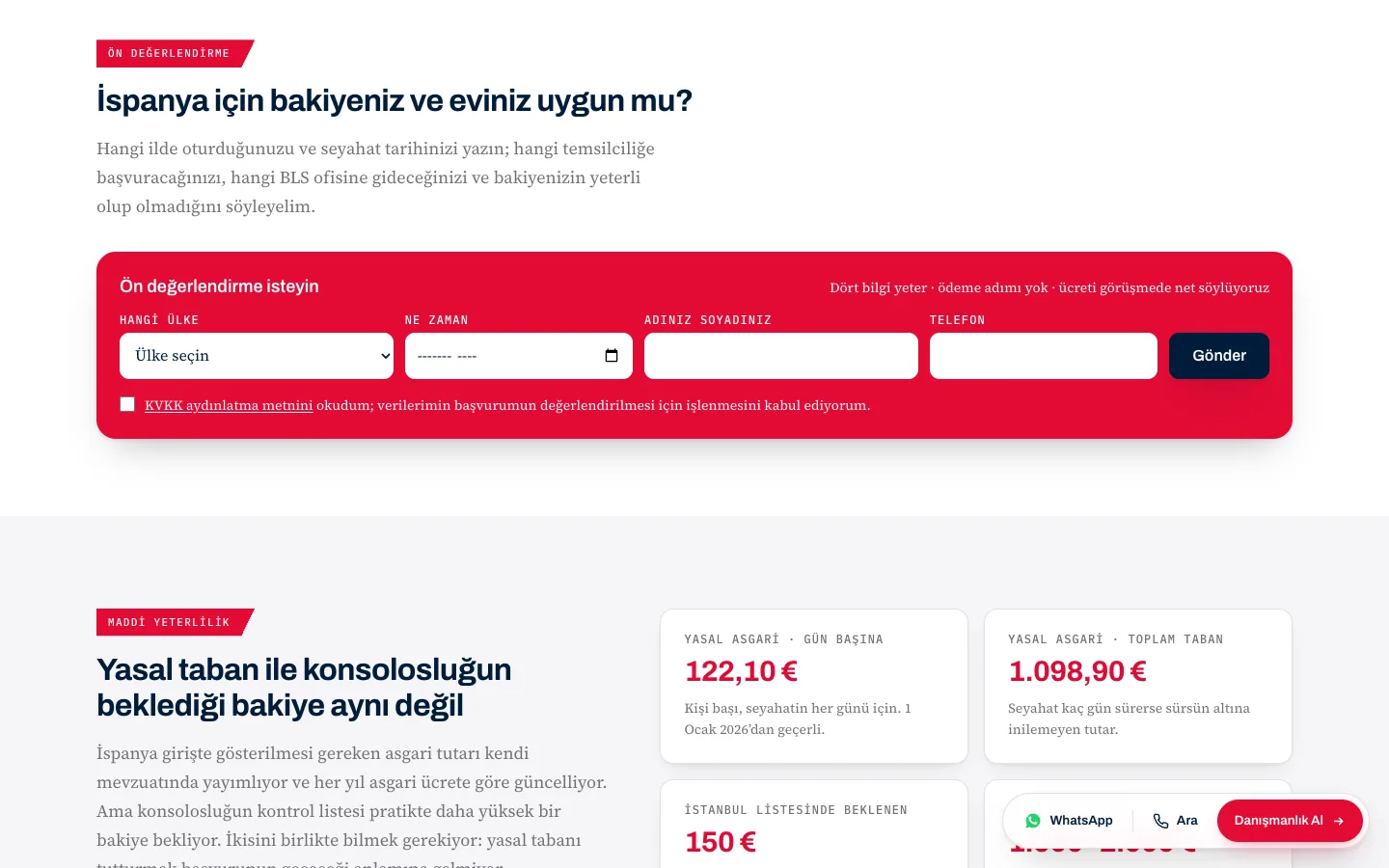
The home page opens with a question rather than a slogan: which country are you applying to? Right under the hero sits a short four-field pre-assessment form; there is no payment step, the fee is stated in the conversation. Below come three visa types by purpose of travel, five services, a grid of 29 countries, the four-step working process, written reviews from four of the firm’s clients and frequently asked questions. The colours come from the logo: ink navy, paper tones and a red accent used only on decision buttons. Fonts are self-hosted and subset for Turkish characters. The site runs on the Mars CMS platform; pages are prepared before publishing and reach the visitor as ready files.
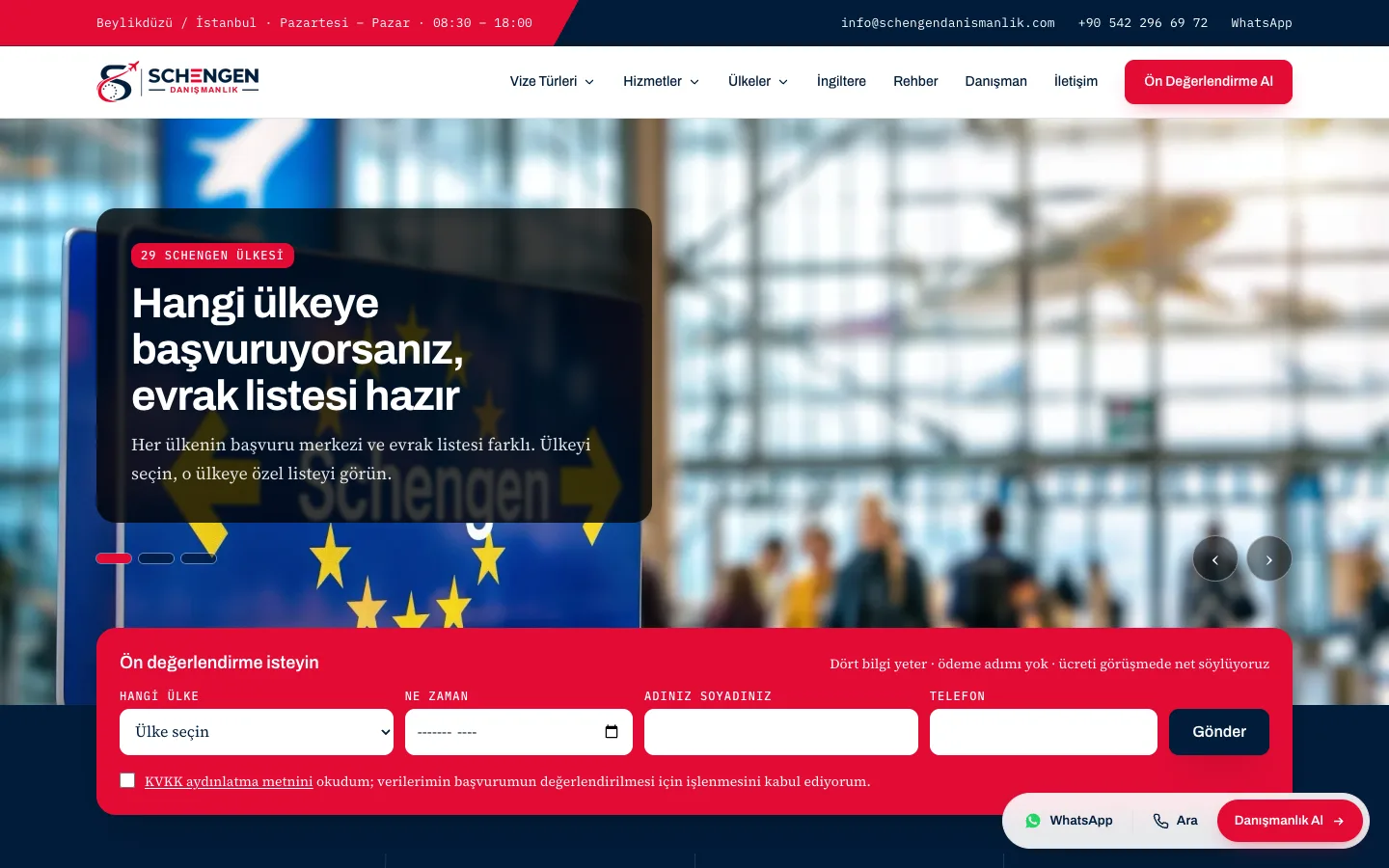
PAGESPEED INSIGHTS · 9 NOVEMBER 2026
96 mobile performance two runs: 97 and 96 100 desktop performance 100 accessibility and SEO 0 layout shift (CLS) -
PHASE 02
29 countries, each by its own rules
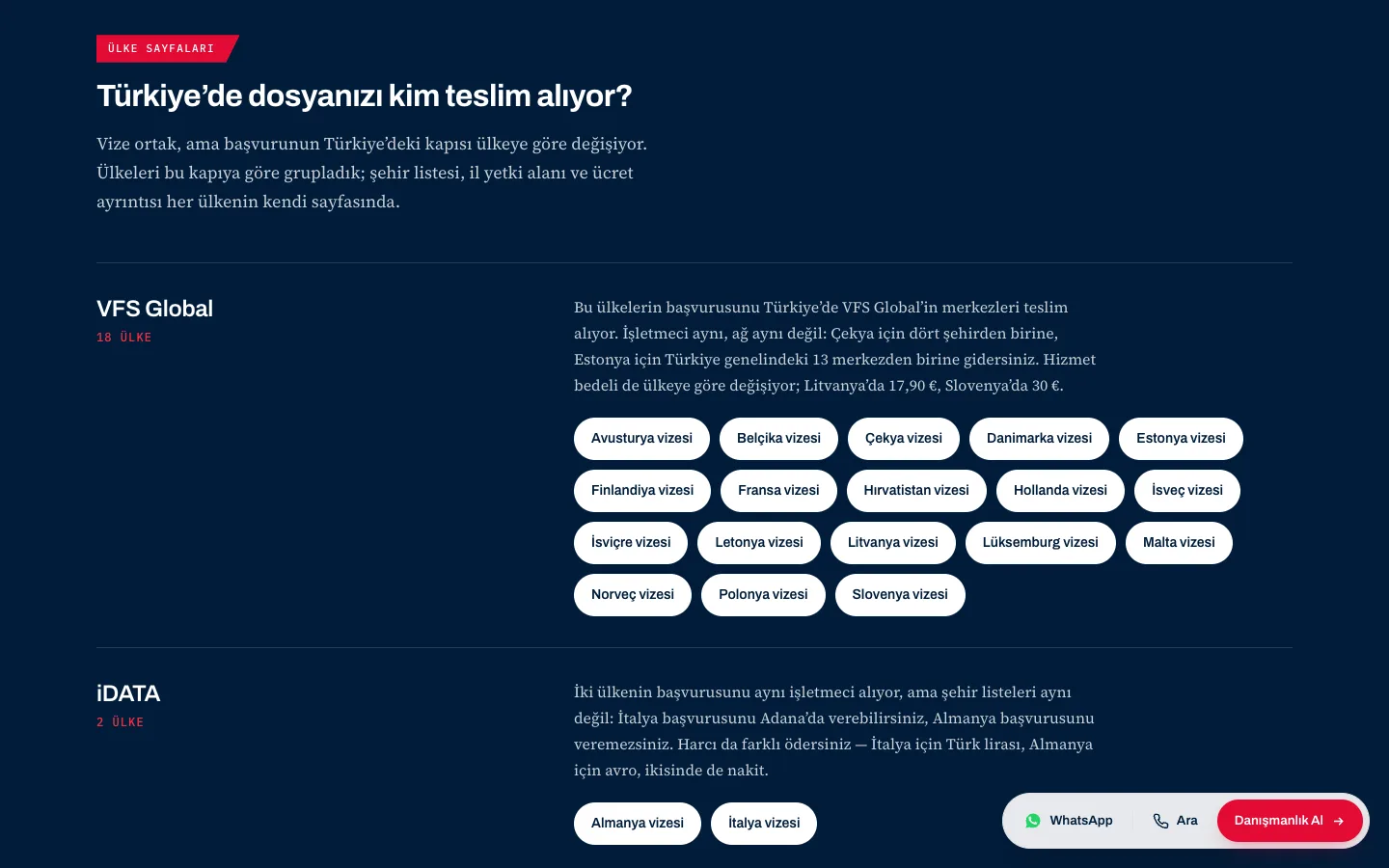
Each of the 29 members of the Schengen area has its own page; the United Kingdom, not a Schengen member, has a separate page built on a separate data structure. A country page opens with a fact sheet: which centre takes the application in Türkiye, in which cities, which mission decides, what the fee is and how it is paid. Every value was verified against that country’s own official source; a field that could not be verified was left empty rather than guessed. The page covers only what is different in that country; the Schengen rules that apply to everyone live on the visa-type and service pages. Each country opens with the thing applicants trip over first there: the calendar for Germany, the province split for Italy, the counter rules at BLS for Spain. Section order and headings were written per country, so the 29 pages do not share a skeleton.
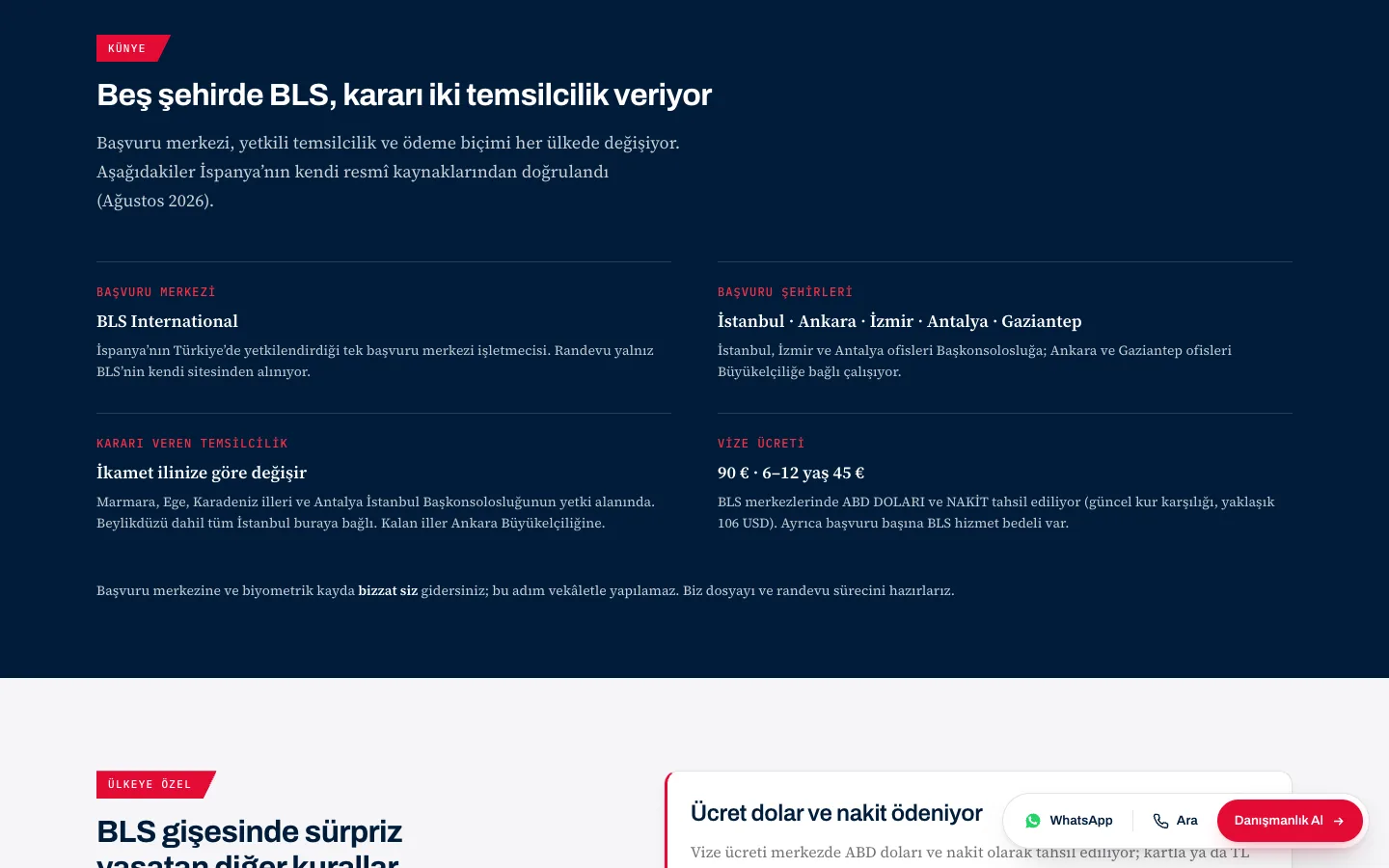
SITE
29 country pages, each with its own fact sheet 5 application centre operators, verified at the source 47 pages in the sitemap -
PHASE 03
Guide: 29 countries in one table
The guide page carries a table no competing site has: the application centre in Türkiye, the daily reference amount and the distinguishing point for all 29 members, side by side. The amounts come from the official reference document that member states report to the European Commission; the document’s name, annex and version date are printed under the table. Rows are summaries and the detail and exceptions stay on the country page; the same number is never kept in two places, so one does not go stale when the other is updated. The Schengen countries page lists the same 29 countries in seven groups by their application gateway in Türkiye and explains the Visa Code’s “which country to apply to” rule in three cases: single country, main destination, first country of entry.
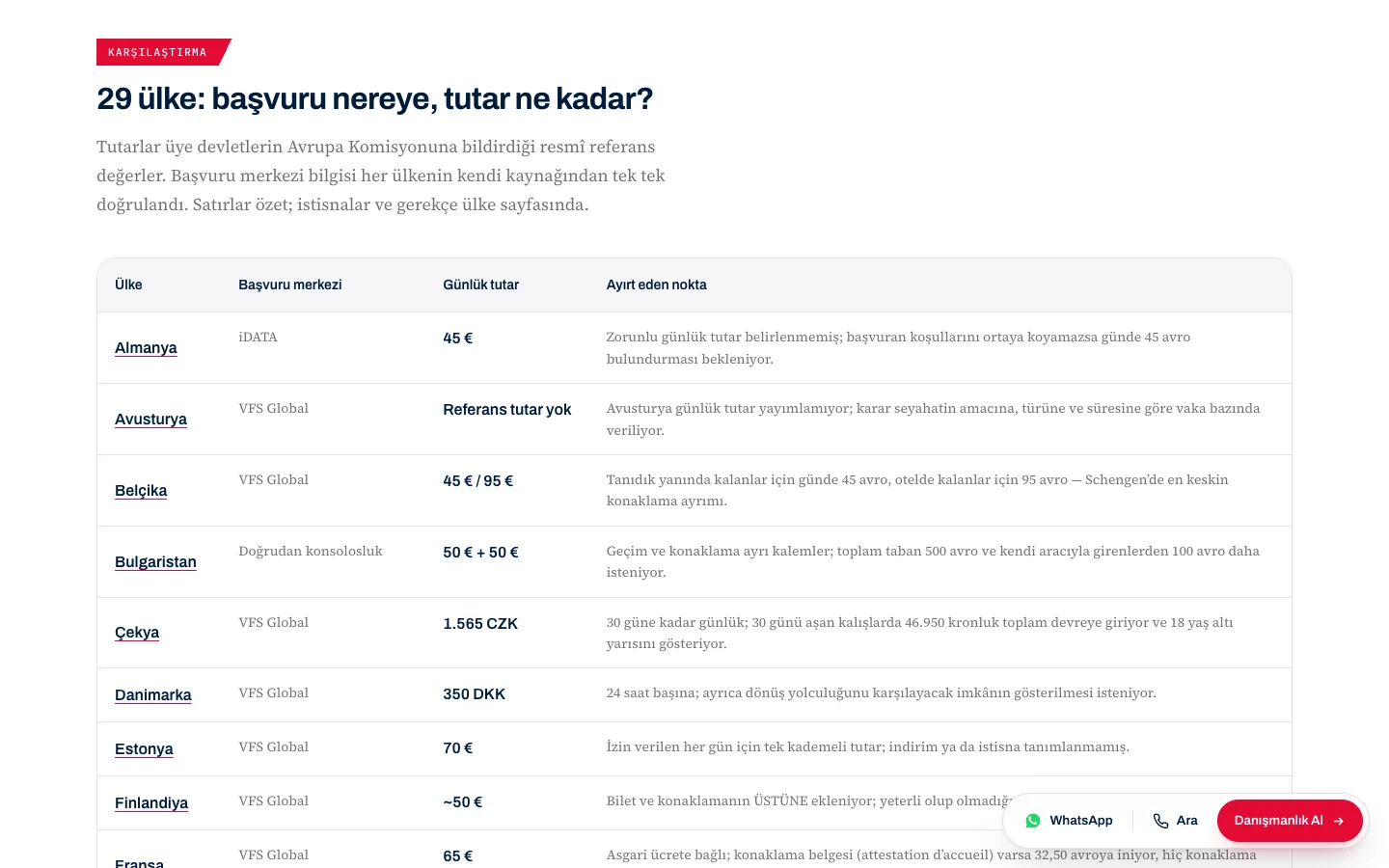
SOURCE · EUROPEAN COMMISSION
29 countries’ reference amounts in one table 7 country groups by application gateway 01.04.2026 document version used, printed in the table -
PHASE 04
Limits instead of promises
Sites in this sector promise success rates and guarantees, while the visa decision rests with the consulate. This site does the opposite. The foot of every page states that the firm is an independent consultancy and not an official application centre. The “What we do not do” section on the consultant page spells out four limits: no promise of an outcome, not an official body, no promise to speed up the process, no part in documents that are not true. In the copy, the person who applies, books the appointment and pays the fee is always the applicant; nowhere does the site appear to take over an official procedure. Trust comes from the way of working rather than claims: the file stays with the same consultant from start to finish, and each of the four steps has a tangible output: a roadmap, a personal document list, a file ready to submit, a checked file.
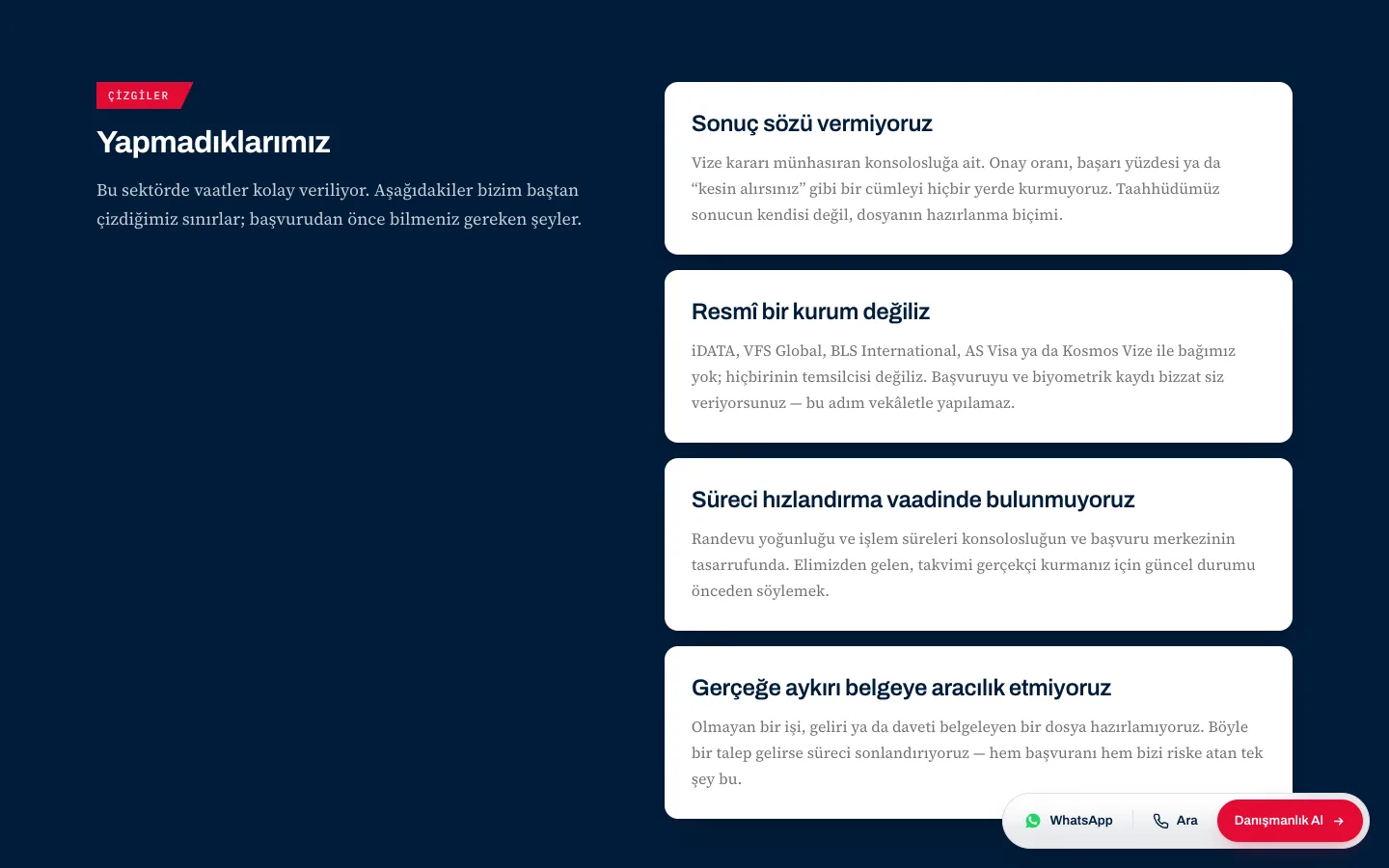
WAY OF WORKING
4 steps, each with a tangible output 4 limits written out plainly 1 consultant from first meeting to final check -
PHASE 05
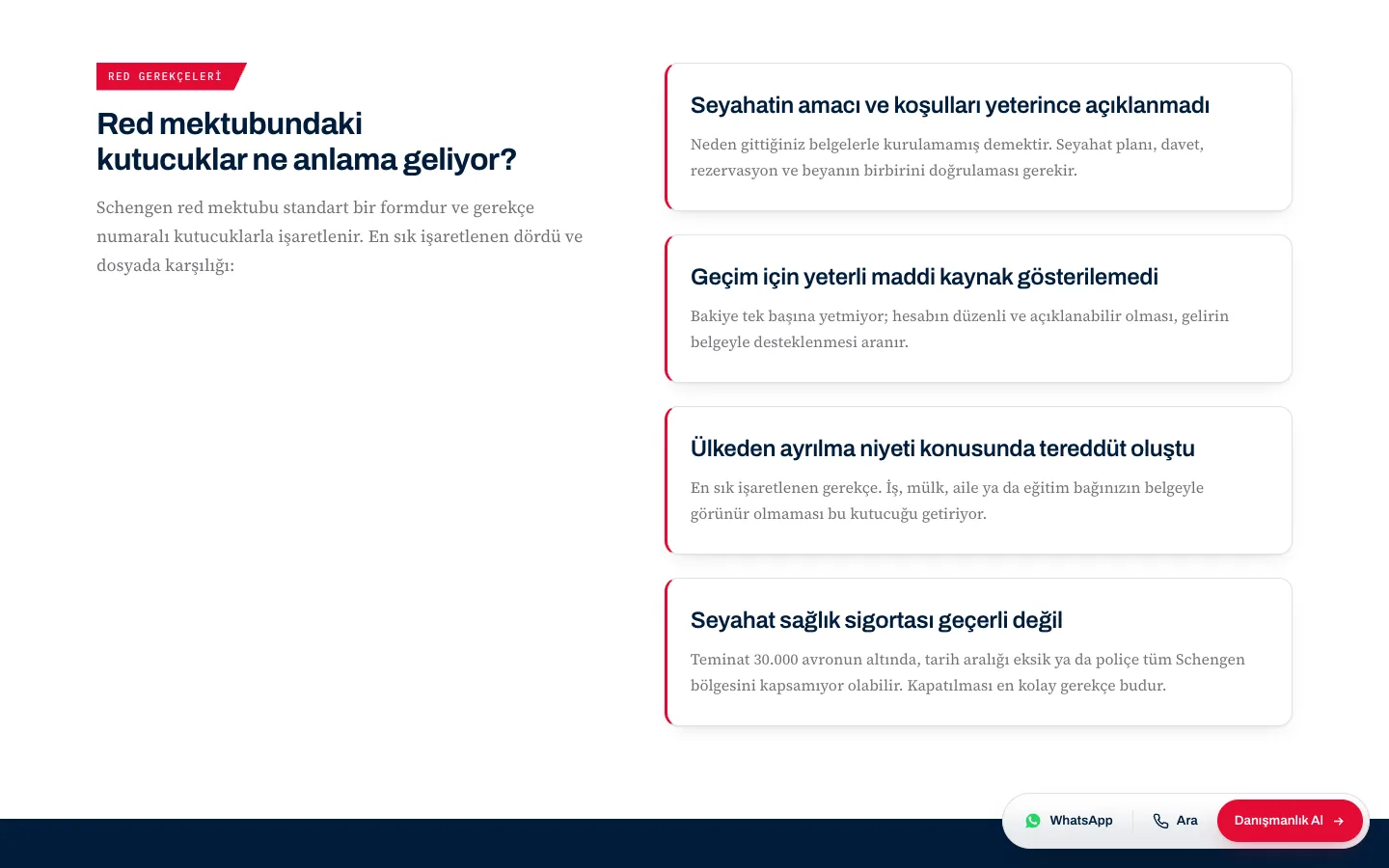
Pre-assessment and after a refusal
In a service without a price list, conversion starts with the visitor describing their situation. The pre-assessment form asks for the country, purpose of travel, dates, employment status and, if there was one, the reason given for a previous refusal; e-mail is optional, a phone number is enough. The request lands in Mars CMS with KVKK consent, and the form is protected against bots. For anyone who would rather not fill in a form, the phone number and WhatsApp sit on the same screen. The warmest page on the site is “Reapplying after a refusal”: it explains what the boxes on the refusal letter mean, the difference between an appeal and a new application, and how the file is rebuilt. On desktop a capsule with WhatsApp, phone and consultancy sits bottom right; on phones a bottom bar stays on every page.
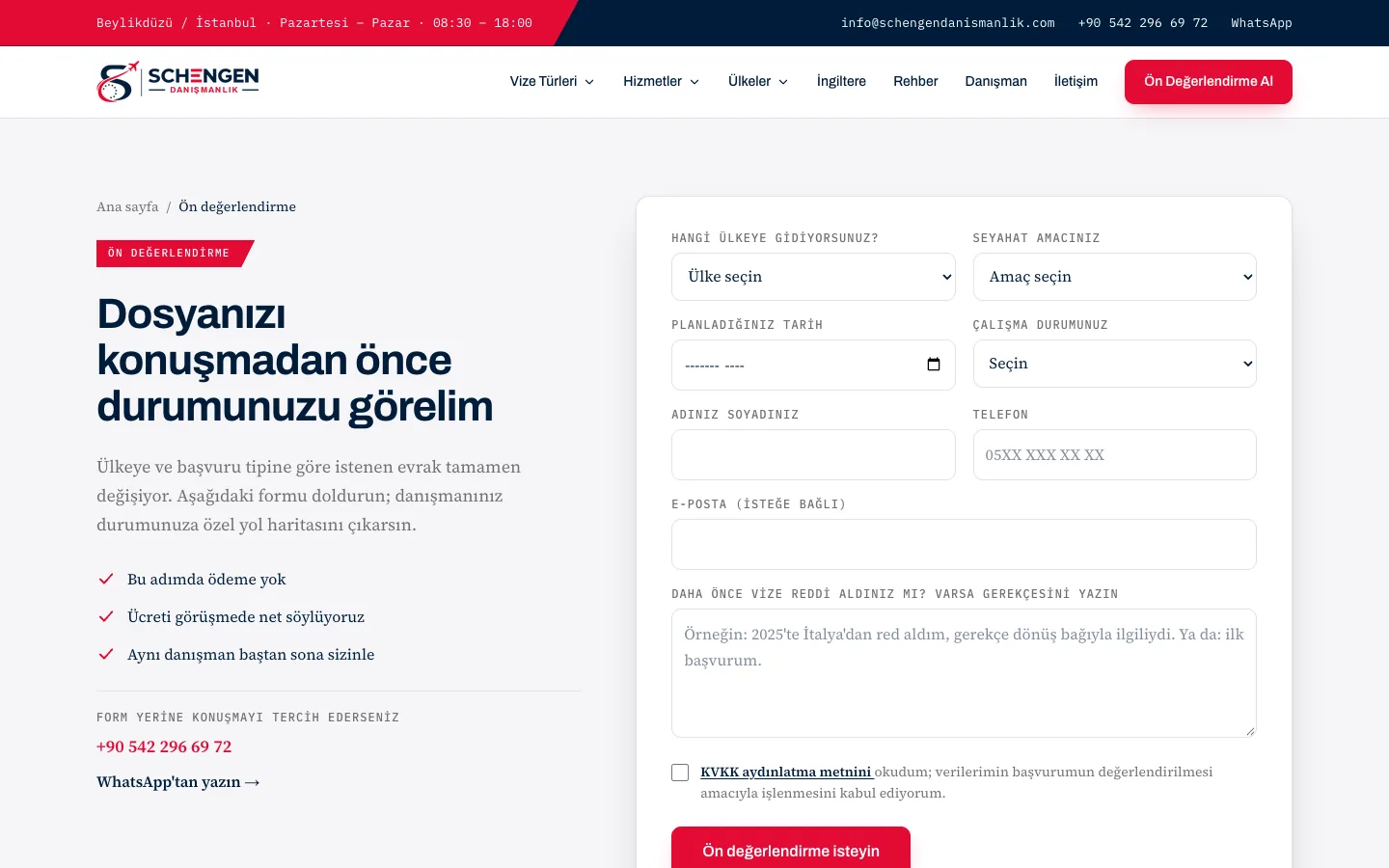
PRE-ASSESSMENT
4 fields are enough on the short home-page form 8 fields on the full form, previous refusal included 0 payment steps; the fee is stated in the conversation -
PHASE 06
Measurement and Google Ads
Google Analytics 4 and Search Console are connected, and cookie consent runs on Google’s Consent Mode v2. Form submissions, phone taps and WhatsApp taps are defined as key events in GA4 and imported into Google Ads as conversions, so the advertising is measured by the contacts that actually happen on the site. We set up a single Google Ads campaign: 16 commercial-intent keywords, Istanbul only, weekdays. The first 30 days brought 6,288 impressions and 331 clicks; the click-through rate was 5.26% and the cost per click stayed 59% below the market average. The keyword that spends the most is not the one that converts best; keyword decisions are made once each keyword has enough clicks behind it.
SHOWCASE
The result.
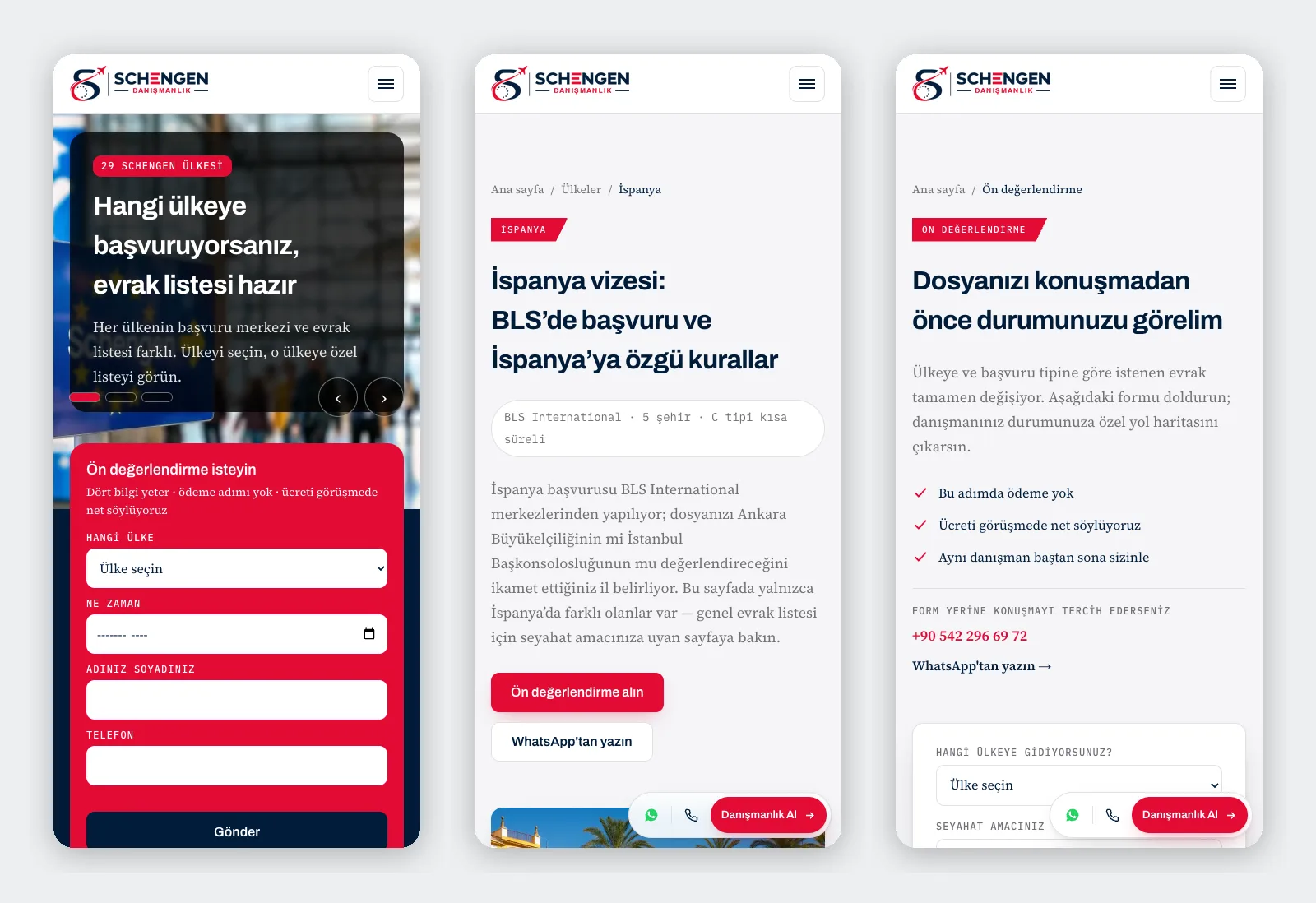
Measured result and project scope
Measurement: PageSpeed Insights (Lighthouse 13.6.0), 9 November 2026, home page: two mobile runs 97 and 96, desktop 100. Google Ads account, 31 August – 29 September 2026; market average from DataForSEO (Türkiye, volume-weighted).
01 · Measurement
96/100
Mobile performance, PageSpeed Insights (two runs: 97 and 96) — 100 on desktop
02 · Measurement
100
Desktop performance; accessibility and SEO 100 on both devices
03 · Result
59%
Google Ads cost per click below the market average (first 30 days)
04 · Scope
29
Country pages, each by its own rules
PageSpeed Insights (Lighthouse 13.6.0), 9 November 2026, home page: on mobile, performance 97 and 96 in two runs, accessibility 100, SEO 100, layout shift 0; on desktop, performance 100 and largest contentful paint 0.5 s. In Chrome user data (CrUX) the page’s loading experience is rated fast. Google Ads: the account’s report for 31 August – 29 September 2026; the cost per click was compared with the Türkiye market average DataForSEO gives for the same keywords. Country and page counts are from the site’s sitemap and data files (9 November 2026). You can test the site yourself at https://pagespeed.web.dev.
CLIENT NOTE
“Our website turned out beautiful and effective. A very good team; they delivered more than they promised. I recommend them to everyone.”
Gökmen Samuk
Visa Consultant, Schengen Danışmanlık — Google review
Translated from Turkish
RELATED WORK
From the same shelf, a few more projects.


YOUR CASE NEXT
Let’s talk about similar work for your brand
Work handled one by one, like this case — it is possible for yours too. We agree the scope, timeline and priorities together.